Monday, 28 May 2012

Race review: UK National Sprint Championships


Last Sunday, I took part in the UK National Sprint Championships which also served as a qualifier for the World Champs taking place in Auckland. The run-up was a bit of a strange one. On one hand, the shorter distances are arguably where I’m strongest and my training has generally been good and consistent over the past few months. On the other hand, most of my training has been aimed at July’s Ironman and, although I got in some great hilly bikes and trail runs while staying with my family the weekend before this race, the rest of the week was spent at weddings and catching up with friends. I managed a few runs but it’s fair to say that there were also many beers drunk – probably more than I’d drunk in the past six months in total!

Shockingly, the sun was shining in the UK and, as anyone who’s ever lived there or visited knows, this is when London is at its best. Runs around Hyde Park and along the Thames Path were glorious sun-drenched affairs, while the days became long, lazy picnics and afternoons in beer gardens. I had a fantastic time catching up with friends and family alike, which meant that I had a little bit of a motivation issue when it came to the race. But I think I did manage to get my head in the game.

The location for the race – Emberton Country Park around 22kms from Milton Keynes – was pretty idyllic, even if it was a bit of an arse to get to, and the organisation on race day was top notch. It was great to line up again in a full and buzzing field of hundreds of triathletes. Abilities varied a little but, by and large, there were less first-timers in the field and many, many more experienced athletes.

I was in one of the last waves, starting at 8am, and by that time I’d already seen my T2A team mates Flanners and Le Pelley take to the waters to battle with their age groups. The water was cold, tho not as cold as I’d feared, although there was quite a lot of floating tree debris about. Sections of the lake were also shallow enough to rag your hand through some underwater foliage.

I lined up well for the swim, got a decent start (although this was a tougher and more physical start than anything I’d been involved in before) and got away with four or five other swimmers. One guy took off – I didn’t follow his feet but, in retrospect, should have busted a gut to stay on his toes. The next guy went through and I stayed on his feet, just, for half the lap. I don’t know if it was the fact that I had other guys with and ahead of me (something I’m not used to – sounds immodest but genuinely have little experience in this scenario) or maybe it was the fact I’d swum just once in two weeks and was swimming in a wetsuit for the first time in ages, but I just didn’t feel like I got into any sort of rhythm in the swim. It felt bad and, for the first time, I was glad to get the swim over. 9.50. Third in my AG.


T1 wasn’t super clean but it was OK-ish, and I came out with three or four other guys from my AG. Although you wouldn’t call the 20k loop mountainous, it certainly wasn’t Ghantoot flat either, with four or five decent bumps, one long section that ground into a slight incline, and one proper, no-doubt-about-it hill in there. 

I’d been working hard on hills while staying at my parents’ house in preparation for Austria as climbing is something I’m not good at, but I was surprised to find that they didn’t stop me dead as anticipated. In fact, I’d say that, on the hills, for every person in my wave who overtook me, I overtook another one or two, while holding steady on the straights and downhills – except for a couple of uber-bikers who shot through. I had a few issues with the drafting rules – a couple of times, someone passed me at speed and then seemed to slow down when in front, forcing me to drop back and ride slowly for a few minutes until I was sure I could pass them – and am pretty sure that I could have knocked a little time off if it’d been a straight individual TT for that reason, but I came into T2 having ridden under 32 minutes which, given the terrain and the fact that the time included some fiddly footpath sections coming into and out of the park, I was pretty darn happy with. Actually really enjoyed the interesting ride terrain too.

I reckon I was lying in around 7th or 8th at this point. The run was two laps of the park – 5.5km in total. I didn’t have my Garmin for the first time so ran to feel (all-in!) and felt OK but not spectacular. But it became hard to keep the head in the game as athletes with the letter F on their calves (my wave) came past at speeds I just couldn’t hold on to. I kept going at what I thought was a decent speed and also overtook a couple of guys in my wave – a new experience for me! I got quite a bad stitch halfway through the second lap and thought I may have to stop but just slowed for a minute or so then carried on.


Crossing the finish line, I pretty much knew where I’d come in terms of position (15th to 16th in my age group) and was a little disappointed while also knowing that I’d raced hard. In retrospect, I think I had a little more to give on the bike in a couple of sections but that may have made 10-20 seconds of difference all told. 

When I saw my time, however, I cheered up a bit. My run was 21:28 for 5.5km – the first time I’d gone under 4 min/km and pretty comfortably so. My overall time then, I concluded, was probably about as fast as I could have hoped for and, allowing for the longer run and the terrain, was definitely in the PB ballpark. 

So, bit bitter-sweet if I’m honest, but always keen to draw the positives from these experiences.

Things I learned:
  •  I’ve said since I started doing triathlon that improvement was how I would define victory. Therefore, especially given that my training is mainly focused on Iron distance racing right now, the fact I’m still getting faster has to be counted as success.
  • The level in the UK is extremely high. I’d say that one or two of the athletes would run away with the V in our local Dubai races but what is more impressive is the strength in depth just behind them. The top 10 is hard-fought.
  • That said, I’m definitely at the right end and have nothing to be ashamed of. When the time comes to move back to the UK or Europe, I’ll be able to hold my head high and have a decent go.
  • My running is improving.
  • My running is improving frustratingly slowly. 
  •  I need to work on leg strength – I was happy with my bike ride but found that, although I was pushing as hard as I could at any given time, I could also have actually ridden at that pace for another 20km loop. I need to turn that into an extra gear in these races.

Wednesday, 23 May 2012

Home is where the hills are


Last weekend, I escaped the steadily rising heat of Dubai and made for the UK for a 10 day holiday that, until now, has been really most pleasant indeed, old chap. The plan was to spend a few days at home in North Wales catching up with family before heading down to London for five days of eating, drinking, sightseeing and catching up with friends. Bookending the trip were my cousin's wedding and the UK sprint tri national championships.

I arrived in Blighty on Wednesday avo, dear boy, and on Thursday I headed out for a 14k run with a chum who is also a keen runner. The plan was to follow my scheduled run – a 75 minute effort with effort increasing by 5% of max heart rate every 15 minutes. What I discovered was amazing – at some point between leaving Dubai and heading out on this run, someone must have issued me with an extra lung. In Dubai, 70% max HR generally means around 6 min/km pace; in the UK, that pace required an effort closer to 60% max. Equally, at the top end, the final hard 15 minute interval (85% max HR) meant 4 min/km, rather than around 5 min/km the same effort produces in Dubai. I SAY!

On Friday, inspired by my T2A team mates who had produced a rather spiffing 220km ride back in Dubai that morning, I decided to follow (almost) suit. I chose a long, winding and hilly ride that would give me plenty of tests in terms of terrain and, thanks to the direction I chose, would mean a bit of a head wind all the way. As agreed with coach, this was about miles in the legs and getting used to the hills, but not going all-in, so steady with some decent rests was the name of the game. 

I was excited to head out but, at the end of the drive, quickly turned around to add an extra three layers of clothing, gloves and a woolly hat under my helmet. I was tempted to pour a piping hot cuppa tea into my drinks bottle but resisted. But it was grim out – drizzling and icy cold – May in the UK!

In spite of the weather, the ride was generally good. I headed out west along the North Wales coast, through Flint, Prestatyn, Rhyl, Colwyn Bay and as far as Corwen – flat and fairly fast, although into a wind rolling off the Irish Sea. 
Could be worse: could be swimming in it!
60Km in, I stopped for a coffee and sandwich then headed inland past Betws y Coed and through the foothills of the Snowdonia range before following the A5 through Conwy and Llangollen. 

Boredom had, perhaps, kicked in by the time I decided to start photographing my food!
There, I knew it was a hard slog home, with two big climbs (one of which was the dreaded Horseshoe Pass) between me and nice warm shower. The final climb up from Ruthin almost killed me, but I felt great to have done it and ended up with a ride that measured 185km in distance, with almost 2,000m of climbing – half of which came in the last 40kms. I took my time (6.5hrs total ride time; 7.15 total time) but it was quite the stiff test, old chap.
In the valleys, boyo.
During the ride though, I made some observations:
  • Riding is way more fun when it's not done on a pancake flat loop after loop after loop after...

Coffee stop!
  • Rides with coffee stops are awesome.
  • I've done a bit of cycling in many countries around the world and would put the quality of the UK's roads marginally behind those of Laos but a tad better than Tanzania. They are, in short, a disgrace. Some sections were so bad that I could have done with a MTB.
  • The UK's bugs have a fairly kamikaze attitude towards flying into cyclists' mouths and up their noses. You can actually see them coming but can't do anything to avoid them.
  • During the day, on any main UK A road, 60% of traffic is articulated lorries and tractors.
  • British drivers are not particularly tolerant of cyclists: around 2 in every 5 cars gives you a decently wide berth; around 1 in every 10 articulated lorries and tractors even notice you.
  • You can chip a tooth on a Gerard's oatie cake unless you get it straight out the oven.

I managed another few hilly runs and trails runs (even got a swim session in) during the rest of the long weekend at home and on Monday headed out again on a long ride. This time, I decided, I'd substitute the big climbs for the sort of rolling terrain I expect to find at Ironman Austria and so headed through the Welsh towns of Conwy and Llangollen and out into Oswestry, Ellesmere, Whitchurch and Chester, before heading home. A 157km ride that took a dab over 5 hours of riding.
Meadows of Cheshire.
Were the roads of Shropshire and Cheshire any better than those of North Wales? Incredibly, if anything, they were worse. But the sun was shining and that changed everything. The terrain – hills, valleys, meadows, canals, lakes, railways... - was utterly breathtaking. The UK, at its best, I was reminded, is as beautiful as anywhere else I've ever been. But with shit roads.
Gorgeous lake in Ellesmere.
My final ride of the week was just a cheeky little two hour outing through country lanes and popping over a local set of foothills a few times for a 50km ride with around 1,200m of elevation. As I reached the peak of one mini summit, just about Hollywell, the view across the Dee Estuary to The Wirral pretty much took my breath away. If only the sun always shone in these parts! 

Climbing is something I really struggle with but these three rides have made me feel much stronger and demonstrated to me that, while I'm a long way short of where I need to be, there is hope... I just need to keep putting the hard work in.

So, for now, the riding is over as I'm heading down to London for a few days where, as well as the rest of the shenanigans mentioned above, I'm looking forward to taking advantage of this weather to get in a couple of long runs through the big parks and along the Thames, before taking my foot off the gas a little on Friday and Saturday before the race on Sunday.

I've no idea how I'll do in that race – the competition looks stiff and I'm not in 'sprint' shape really, being just 5 or 6 weeks short of Ironman Austria, but I'm looking forward to getting out there, giving it some and seeing where that puts me. It'll be nice to see how I compare to other athletes outside my normal Dubai circle.

Monday, 14 May 2012

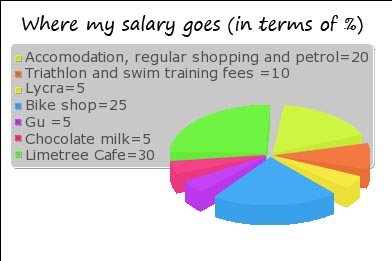
Where my salary goes...


25 signs that you’re a Dubai triathlete

  1. Your training wheels are made of carbon.
  2. In spite of normally being pretty shocking at mental arithmetic, you’ve a Rainman like ability to instantly know what combinations of loops, laps and doglegs at Ghantoot, Longtoot and Nad Al Sheba will add up to your day’s training target.
  3. You have a full draw of arm warmers, knee warmers, shoe covers, thermal headbands and gloves for when temperature ‘plummet’ to 14°C.
  4. You’re used to getting weird looks for cycling in the same direction as traffic.
  5. You consider a 30°C run to be cool.
  6. You don’t moan about paying 40% more than anyone else in the world for gear and accessories.
  7. You’ve never cleaned your chain yourself.
  8. Heading out in the morning, you’ve bumped into your housemate or neighbour just getting back home.
  9. You’ve forgotten what it’s like to swim indoors.
  10. You consider a flyover to be a climb.
  11. Your A race is in a different continent.
  12. You enjoy a love-hate relationship with Al Ain and Hatta.
  13. For years you thought Gu was the only type of gel available, 2XU was the only tri gear manufacturer, and all bikes were made by Scott.
  14. Starting a ride at 3am seems entirely reasonable, and even sensible.
  15. You’re Facebook friends with all the local bike shop owners.
  16. You can’t remember the last time you had to rack your bike in any particular order at a race.
  17. You’ve never raced in the rain.
  18. You have three different bikes but have never once even considered riding to work.
  19. You don’t know what a ‘trail run’ means.
  20. You don’t know what ‘hill reps’ mean.
  21. You’ve had a ride slowed due to camels on the road.
  22. You’ve tried racing gazelles. Gazelles win.
  23. Your wetsuit gets used for about three weeks a year.
  24. Your cupboards contain more water bottles, freezer bags and eskies than cups, plates and glasses.
  25. “HOLE!”


Monday, 30 April 2012

Fitness testing - the full story


Believe it or not (and I realise that most people won’t), there’s actually a fair amount of work involved with this here blog. I know that it seems like I just scrawl out whatever random musings materialise in my noggin, but I do actually but some thought and time into it... and that’s the excuse I’m using for the couple of weeks that have come between my first two Aerofit scan postings and this here one.

On a serious note, it’s an interesting and worthwhile subject, and I didn’t want to do a rush job. The past couple of weeks I’ve been busier than a one-legged man in an ass-kicking competition and just couldn’t find the time, but the best things in life are worth waiting for, right?

So, here we go with analysis of my cycling and running. As it’s been such a long time between these posts, I decided to paste posts 1 and 2 to the beginning to create one long but, hopefully, continuous and intelligible post. If you have an elephantine memory, just skip down to the bottom to the part where you see a load of scientific looking graphs and read from around there.

For the rest....

-----------

Anyone who takes a look at that little bar above (the one that says ‘Follow My Training’) will have noticed quite a difference in the way I train of late. Of course, it still boils down to swim/bike/run/core/stretch, but the way sessions are approached has changed.

Previously, for example, you’d have seen things like ‘24k long run’ or ‘60k bike into 40minute harder run’. But these have now become ‘25k in upper Tz1 [Training Zone 1]’ and ‘60k Tz1-Tz2 into 40 minute run in Tz2’.

So, where did all this extra information on training zones come from? My Aerofit scan.

Triathletes, as I’ve said before, love a bit of geekery – in the form of carbon goodies, shiny new gadgets and analysing data. And there’s lots of data that can be analysed: VO2 max, lactate threshold, average watts etc...

One recent innovation to find its way to the Middle East is Aerofit (it was originally pioneered in Germany but is now available in loads of countries around the world). But, as Sreeya from Aerofit explains, they see their scan as more of a training tool than purely a fitness test used to produce data.

“We see it as the leading fitness coaching service in the Middle East, which guarantees you effective weight loss and improvement in your sports performance. We can provide individualised ‘fact-based’ training plans based on a scientific analysis [called the Aeroscan] of your individual metabolism.”

Fair enough. So, how does it do that?

“AeroFit determines your VO2, anaerobe threshold, fat and carbohydrate metabolism and optimum training zones,” answers Sreeya.

Unless you’re already pretty health savvy and into the science of fitness, much of this will be as intelligible as a sea lion singing karaoke – what we actually want to know about any of these tests or scans, if we’re being honest, is one thing: will it make me faster?

“You will significantly improve your stamina, speed and endurance by training your body to produce energy efficiently. You will get much faster on the run and bike, be able to estimate your racing times, strategise the right pace for your next race and plan your nutrition intake to fuel your body sufficiently,” says Sreeya.

That’ll be a ‘yes’ then.

“You will see your race times improving and visibly see progress in just a few weeks of training.”

From my basic understanding of the science behind the Aerofit scan, all athletes can choose to train at a wide range of intensities – you can walk, you can sprint, or you can do anything in between. Whether you’re a Kona qualifier, a mid-pack triathlete, or just someone who wants to lose a bit of weight and get a little fitter, the major limiter is almost always time. The data provided by the Aeroscan tells you what intensities you should work at to maximise gains in the time that you have available.

So, what does doing the Aerofit scan involve?

Well, it’s pretty simple really – and no more taxing than the average gym session. A couple of days before, I fill in an information sheet which lists things like my age, weight, how much I exercise and my fitness goals. This sheet also includes a set of fairly straightforward instructions, telling me to keep vigorous workouts to a minimum in the 48 hours preceding my Aerofit scan, and not to eat for a few hours before.

I arrive at the gym at The Address Dubai Mall – one of Aerofit’shomes, along with the Up & Running clinic on Al Wasl Road – and go into the plush changing rooms to don my shorts, t-shirt and trainers.

The only other apparatus involved are a standard stationary bike, a treadmill and the Aerofit mouthpiece – essentially a tube that you place into your mouth and leading to a chord, with a nose pinch that not only keeps the mouthpiece steady but also guarantees that all inhalation and exhalation goes through the mouth. The mouthpiece feeds information into a laptop that records the results.

Before doing anything, I sit down – at rest – and breathe through the mouthpiece for 30 seconds. Then we begin on the bike. I cycle at a steady cadence on an easy resistance for a few minutes and then Sreeya hands me the mouthpiece – I continue cycling just the same put while breathing into the mouthpiece for 30 seconds. 


Sreeya then whips off the mouthpiece and increases the resistance; again, I cycle steadily for a few minutes before I continue but breathing through the mouthpiece for 30 seconds. 


This pattern continues – incremental increase in resistance, a few minutes of normal riding, 30 seconds into the mouthpiece... and then Sreeya tells me to stop, taking down the resistance for me to cool down gradually. It’s pretty painless, took less than 15 minutes and, in terms of perceived effort, I’d say that even at the top resistance I’m still only on 5 out of 10.


There’s a few minutes’ break as Sreeya and fellow expert Markus take a look at the results, walking me through a few of the most obvious points and patterns.


I then jump up on to the treadmill and repeat the process, starting at an easy 8kph (the pace you start at depends on your ability), running for a couple of minutes normally, running for 30 seconds with the mouthpiece on, then upping the pace by 2kph and repeating the process. 


The only difference is that, due to the results I was registering, I stayed on the treadmill longer than I did on the bike and was at a fair old pace (for me, at least) by the end of the scan – just over 17 minutes later. The whole process took around an hour for both bike and run.


Again, I cooled down and watched as Sreeya and Markus looked at, translated and explained my results.

So, here’s the bike results:

And here’s the run:

But what do they mean? Well, let’s go back to the bike.

You can extrapolate all manner of conclusions from this; everything from my base metabolism to how many calories I’ll burn/require during an Ironman bike leg, given my effort of level (as reflected by my heart rate). If you know what you’re looking for, there’s as many answers here as there are questions. But, in a nutshell, these are the vital stats:

Again, you can interpret all this is any number of ways but my primary aim was to discover my training zones and which ones I need to work on most. Information like this:

Sreeya and Markus explain the results:

“Every human body has approximately 1,700-2,000 Kcals of carbohydrate storage whereas a substantially higher amount of fat storage of approximately 80,000 Kcals. Hence, in order to improve your fitness and sports performance or lose fat, it is important to train your body to burn more fat calories, which can happen by training in your correct heart rate zones.

“For endurance athletes, as long as you keep burning fat, you are using an almost unlimited storage of energy and you will be able to perform at these levels for very long periods of time. It is only when a very high amount of your calorie consumption comes from carbohydrates, in your case at HR 128 or 210 watts, your endurance for long distance events will go down significantly.

“Overall, you have a low fat metabolism. Your highest fat burn rate of 63% is achieved at HR 88 and 60 watts followed by a very sharp decline thereafter. Your anaerobe zone is reached at HR 137. Majority of your biking should occur in the aerobe zones, TZ1 and TZ2. Your training should primarily focus on building fat metabolism. Do long bike rides in TZ1 up to HR 110. This will increase your overall endurance for long distance races as you are training your body to burn more fat calories of which you have an almost unlimited amount of storage. In addition, do some bike rides in TZ2 especially during racing season. This will improve your stamina and speed performance and push out your anaerobe threshold further to the right. However, it is important to first focus on building fat metabolism in the low-medium HR to improve overall biking profile.”

Some people show vastly different results in bike and run. They may, for example, be an extremely efficient runner who burns predominantly fat until a very high speed however, when they jump on the bike, they have to work far harder and therefore burn predominantly carbohydrates unless they keep their heart rates very low.
That isn’t the case for me, however; my bike and run show very, very similar results and Sreeya and Markus were able to make almost the same conclusion.

To conclude, it’s clear that I’m a pretty fit person who is well-trained. It’s also clear that I’m predominantly a shorter distance, power athlete, rather than a natural endurance athlete. This is backed up by the fact that, even when a lot younger and when I was a competitive swimmer, I always specialised in the sprint events like 50m-100m fly and backstroke. I made regional school track finals in sprints and hurdle events, but you’d have found me at the back of a cross-country, in spite of my aerobic capacity garnered from swimming. And although I’ve been doing triathlon for a couple of years now, I’ve still not had enough time to build that big aerobic (fat burning) base.

In which case – as I’m saying that the Aerofit scan backed up what I already knew – does that make it pointless?

Not at all. As I’ve explained, there are all manner of results and data you can pull from this and some of the more interesting information for me revolves around the number of calories I burn per hour at a given rate of exertion. This has helped me to really nail a nutrition plan for my upcoming Ironman.

But the zones themselves have proven useful. It’s all very well to say, as someone still relatively new to endurance sports and is built for power rather than distance, I need to train long and easy to build an endurance base. But what is ‘long and easy’. Having those exact figures – those magic numbers if you will – has informed all my longer training since to the point that, when doing my longer  solo sessions, I no longer even have the speed/pace on display on my Garmin, judging everything on heart rate.

A few days ago, I went out and did one of my longest runs I’ll do for Ironman – a 32km effort – and based it purely on not exceeding the 70% (130bpm) heart rate that the aeroscan outlined. This kept it steady but, most surprisingly of all was that, by the end I felt pretty good. My legs were getting a little bit sore (I’d been running on hard paving rather than kinder trails or tarmac so this was to be expected) and I was thirsty (I’d kept hydration and nutrition down to pretty minimal levels) but still felt better than I’d expect to after this sort of training run. Turns out I’d only been running  a little over 6min/km, but the pace is of little importance in this sort of run – by keeping steady and at/under the magic number, I’d felt none of the usual peaks/troughs I’d have expected to feel during that sort of run and, to boot, I recovered really quickly too, ready to train the next day.

The acid test, of course, will come on Ironman race day. Can this training be turned into a goal time over 140.6 miles?

Tuesday, 17 April 2012

Tri Yas - race report


Gah, don’t you hate it when work, training and, well, life get in the way of some questionable quality blogging action!

Anyway, bit of a round-up. Last weekend, as I said, was Tri Yas – an event I really enjoyed last year and so was excited to do again this year. Last time out, I did the Olympic distance race but this time, as I wasn’t really supposed to be racing at all due to being in full Ironman training mode (11 weeks!), I decided to do the sprint distance race as this would probably have least bearing on any training.

Friday morning’s session was meant to be a 15km run into a 120km bike but I shifted a load of stuff around and got up at the crack of dawn on Thursday morning to do the session before work rather than Friday morning before the race. In the end, I only got 105km of the bike in, due to being chased back to the car by a Mission Impossible: Ghost Protocol style sandstorm, but it did the trick.
"Bugger!"
As Yas was an afternoon/evening race, it meant I managed to get (almost all my training in), be a little tiny bit rested for the race and, most excitingly, I got to enjoy my first Friday morning lie-in for probably 18 months.

The race itself was really well put on, with the exception of it dragging somewhat – I had to be there to register, rack up and be out of transition by 3, but my wave didn’t start till 5.15. By the time I left after presentations (there’s a clue as to how I did) it had gone 9pm... which is a long day for a sprint!

There were a few small murmurs about the course being long (turns out the swim was probably 850m and the bike was 22.5km) but it was what it was and, from my point of view, it was about time the swim was long, as every other race this season has been on a notably short swim course.

Anyway, the race was a lot of fun due to the surroundings. The swim took us out into the marina and past the iconic Yas Viceroy hotel before heading back to the dock. I’ve not been swimming fantastically of late but felt good – started aggressively and just kind of kept on going hard. By all accounts, by the time I was heading back along the marina, I’d opened up a lead of 100-200m and came out the water on a time of 10:52 – not bad at all for a swim of 850-900m.

The run from the marina into T1 (the pit lane!) was quite a long one and I managed to pass through pretty quickly without overexerting.

Onto the bike – four laps of the Yas Marina F1 Circuit – and this is probably the most fun I’ve ever had on a bike. Being such a strong swimmer (and not bad on the bike and run), I’m used to only being overtaken as I fall behind the eventual winners and podium finishers, but the wave start here meant that there were plenty of triathletes out on the course already and I loved zipping past them and into the tight corners. I also felt great and was pushing hard and fast through the pedals all the way around; my aim was to get into T2 before my team mate Ed, who was also in my wave and is a brilliant triathlete and especially strong on the bike and run. Heading into the pit lane after just over 22kms, I was chuffed that I’d managed to hold on to the wave lead, and even happier when my Garmin showed an average speed of close to 41kph.

Again, it was a long T2, but I felt pretty good heading out on to the run and used the Garmin to control my pace. The intention was to hold a 4.10 pace for the first 1km or so and then bring that down. I hoped to break the 4min/km average for the first time but, in the end, that just didn’t happen. I felt smooth, and continued overtaking runners in front, but just couldn’t quite find the pace I’d hoped for. Still, I held on to the wave lead for almost 4km of the run, until Ed ran past me like a steam train. It was just a case of gritting the teeth and getting to the finish line then.

I crossed the line in 1.08.28 which was enough for 3rd position overall (Ed took 2nd 50 secounds in front of me, while our other team mate Ian, who was in the previous wave, got the W another 40 seconds ahead of Ed – a Tri2Aspire clean sweep, with another T2Aer, Flanners, also taking 4th and Didge pretty much walking to victory in the women’s sprint).
Scary helmet people
Being called up on to the F1 podium was very cool, but I was generally very happy with my race. With little to no taper or specific preparation, I swam and biked as well as I ever have while my run was where I’d expect it to be, even if I’d secretly hoped to see a small improvement... a huge relief after a difficult few months of illness and injury and a really great first indicator to me that I’m back on form, which is great with the UK sprint champs coming up in May and Ironman in July.

The aim at the UK champs is to qualify to represent GB at the age group sprint world champs later in the year. If I do mange to fluke that, this is a good base to work from. With the focus on Ironman, I’ve done little to no speed work of late and am confident that, after IM, I can really improve across all three disciplines, but the bike and run in particular. 

Thursday, 12 April 2012

Under starter's orders...

Sorry, will have to conclude the posts on the Aerofit scan next week. Been super busy today, time has run away with me and the results of the Aerofit are, I think, really interesting, so I want to take my time over that post.

Fun weekend coming up with what will definitely be my last race of the UAE triathlon season - Tri Yas. Given that I'm into my Ironman training block, I probably shouldn't be taking part, but it's a cool event - the swim is in the marina in front of the hotel, transition takes place in the pit lane, and the bike is on the actual F1 track... so I couldn't resist.

By way of a compromise, I've managed to fit in tomorrow's training during the rest of the week and am just doing the sprint distance (there's an Olympic distance race too) so recovery will be quick and painless.

It's done in waves and I'm in the last wave of the day which is awesome as it means there'll be other people out on the course, so I'll actually get to overtake some athletes (passing people is a rarity for me; due to my strong swim, I'm usually the hare who gets caught)... so I'd like to take this opportunity to apologise in advance to anyone racing tomorrow who has to put up with me making a high-pitched F1 car transition noise all the way around. Especially if I happen to overtake you and make a 'changing down' noise in the process!

Will report back next week.

Have a nice weekend everyone.